A Closer Look On Psilocybin
By Ria Pande
Psilocybin Uses
Psilocybin (4-phosphoryloxy-N,N-dimethyltryptamine), found in naturally occurring psychoactive mushrooms, has been the focal point of a variety of recent clinical studies for its distinct therapeutic benefits, especially for conditions including Major Depressive Disorder and Treatment-Resistant Depression. More recently, studies displaying psilocybin’s potential to increase both healthspan and lifespan within humans have been emerging, which could alter the way we perceive this drug currently categorized as a federally illegal Schedule I substance through the U.S. Controlled Substances Act of 1970.
Outcomes Of Mice and Human Studies
Within mice, recent studies have shown that 5-HT2A stimulation in cortical neurons caused SIRT1-dependent expression of antioxidant enzymes. This process led to reduced oxidative stress and increased neuroprotection. SIRT1 is a vital enzyme with functions of regulating DNA repair, cellular senescence, and aging, with overexpression of SIRT1 having the ability to extend organismal lifespans of C. elegans and mice.
When taking a closer look at what occurs within human cells after administration, we can see that psilocin, which is the active metabolite form of psilocybin, causes delayed cellular senescence, reduced oxidative stress levels, and preserved telomere length. In addition, the researchers at Baylor College of Medicine found that SIRT1 expression was also increased within human cells, with effects of increased DNA repair and improved longevity for these cells.
Cellular senescence describes the process of cell-cycle arrest when a damaged cell stops dividing but remains metabolically active. This process is beneficial for processes like cancer prevention and wound healing in young tissues, but as senescent cells continue to linger, they secrete a toxic mix of inflammatory molecules, growth factors, and enzymes. This toxic combination is called the Senescence-Associated Secretory Phenotype (SASP), which ends up degrading surrounding tissues and forcing healthy neighboring cells into senescence as well. Cellular senescence being delayed through psilocybin administration allows for tissue to have a reduced potential of secreting SASP, reducing the damaging effects on tissues that result from accumulation through aging. Reducing oxidative stress levels reduces inflammation, prevents disease, causes increased energy, minimizes wrinkles, and improves cognitive function through protection of healthy DNA, mitochondria, cells, and tissues. Telomere degradation is a classic indication of aging. As telomeres, which are protective caps of repetitive DNA found at the ends of chromosomes, shorten as we age, oxidative stress and senescence accumulates, leading to inflammation, disease, and aging, demonstrating how telomere protection is a vital solution to increasing cellular longevity.
Through these processes, researchers found that psilocybin administration had extended cellular lifespan up to 57% within human fibroblasts. This study analyzed specifically skin and lung fibroblasts, but fibroblasts are also found throughout the human body and major organs. Seeing all these processes lead to extended cellular lifespans within human cells gives a positive indication towards psilocybin’s use for improving human longevity as well.
Mechanism Of Action: 5-HT2A to SIRT1
After psilocybin is administered through ingestion, rapid dephosphorylation by the body’s enzymes convert psilocybin into its psychoactive metabolite form, psilocin (5-hydroxytryptamine). Psilocin possesses structural similarity to serotonin, which allows it to easily interact with the brain’s serotonergic system. After dephosphorylation, psilocin acts as a non-selective agonist at 5-HT2A serotonin receptors, where this receptor interaction disrupts the brain’s default mode network and leads to commonly known effects such as hallucinations. From here, psilocin binds to the 5-HT2A receptor in cortical neurons. The 5-HT2A receptor is coupled to the Gq/11 heterotrimeric G-protein, so psilocin binding causes this Gq/11 subunit to exchange GDP for GTP and to induce dissociation from its βγ subunits, allowing for Gq/11 to be activated.
This activated Gq subunit activates Phospholipase Cβ (PLCβ), which hydrolyzes and cleaves the membrane phospholipid PIP2 to yield two secondary messengers: IP3 and DAG. IP3 diffuses into the cytoplasm and binds to IP3 receptors on the endoplasmic reticulum to release stored Ca2+ into the cytosol. This increased cytosolic Ca2+ and membrane-bound DAG work together to activate Protein Kinase C (PKC). Downstream of this activation of PKC and release of Ca2+, the Mitogen-Activated Protein Kinase (MAPK) is recruited, triggering the GTPase Ras. Ras activates Raf, Raf phosphorylates MEK1/2, then MEK1/2 phosphorylates ERK1/2. This activated ERK1/2 travels from the cytoplasm into the nucleus. From here, the PLC and MAPK pathways are able to recruit SIRT1 (Silencing Information Regulator 2 related enzyme 1), which is a key regulator of various aging related signaling mechanisms.
Beneficial SIRT1 Pathways for Anti-Aging
After recruitment, SIRT1 can proceed through a variety of pathways that reduce the impacts of aging and allows for increased cellular longevity, which ties in with increased organismal longevity.
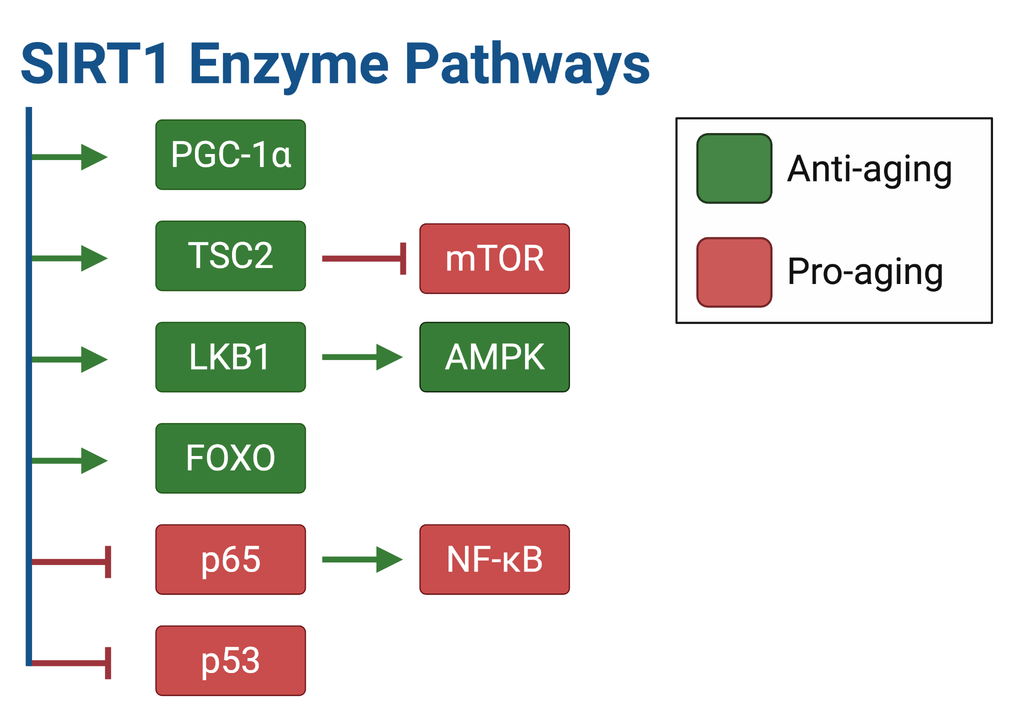
- PGC-1α: SIRT1 is able to modulate PGC-1α expression, which operates as a regulator of mitochondrial biogenesis with the further ability to enhance Nuclear Respiratory Factor 1 (NRF1), which coordinates communication between nuclear and mitochondrial genomes, and Mitochondrial Transcription Factor A (TFAM) expression. This pathway leads to increased mitochondrial biogenesis, increased oxidative capacity, increased ATP levels, and decreased (Reactive Oxygen Species) ROS production.
- NF-κB: Nuclear Factor kappa B (NF-κB) is a major transcription factor activated in many aging-associated diseases caused by inflammation, including arthritis, atherosclerosis, diabetes, Alzheimer’s disease, and Parkinson’s disease. SIRT1 deacetylates the p65 subunit of NF-κB, which deactivates NF-κB, reduces expression of inflammatory cytokines, and causes a reduction in the inflammation associated with these aging-related diseases.
- p53: Tumor suppressor p53 initiates cell senescence. Activation of SIRT1 causes deacetylation at p53’s C-terminal and, therefore, inhibition of p53 transcription, leading to a reduction of cellular senescence and associated functional abnormalities.
- mTOR: Mammalian target or rapamycin (mTOR) suppression has been shown to extend the lifespan of multiple organisms. SIRT1 interacts with tuberous sclerosis protein 2 (TSC2), which negatively regulates mTOR. SIRT1 is able to restore autophagy impairment caused by oxidative stress through blocking the mTOR pathway, which allows autophagosomes to ensure proper clearance of damaged organelles and promote cell survival.
- AMPK: AMPK plays a vital role in cell energy metabolism and cell survival, being proven to extend lifespans of worms, fruit flies, and rodents. AMPK can enhance SIRT1 activity by increasing NAD+ levels in the cell, leading to higher levels of PGC-1α deacetylation and up-regulation of autophagy that delays cellular senescence. In addition, SIRT1 deacetylates and activates Liver Kinase B1 (LKB1), leading to increased phosphorylation of AMPKα, which reduces cellular senescence as well.
- FoxOs: Transposition factors (FoxOs) operate as sensors in insulin signaling pathways and can bind to SIRT1 to regulate cellular senescence, as well as resist oxidative stress.
Other Compounds Utilizing Similar Pathways
SIRT1 activators through the 5-HT2A receptor pathway:
- Serotonin
- LSD
- DMT
SIRT1 activators in naturally occurring compounds:
- Resveratrol
- Quercetin
- Berberine
- Curcumin
- Fisetin
Takeaway Messages
Psilocybin research within the context of anti-aging properties is still very new, so it’s pertinent to give time for full clinical trials to be conducted with this intention before utilizing psilocybin for these purposes. Still, the molecular processes already investigated point to a promising future of psilocybin utilization in regards to potential anti-aging effects and increased longevity.
| Category | Rating of Evidence | Explanation |
| Human Evidence | Weak | Although there are promising trials of cellular lifespan longevity, there is currently no direct evidence of psilocybin increasing organismal longevity for healthy humans. |
| Model Organism Trials | Moderate | There are promising organismal longevity results from trials on mice, however the lack of evidence from other model organisms limits the credibility of the other trials. |
| Mechanistic Plausability | High | The mechanisms that psilocybin interacts with through the 5-HT2A receptor are known to act against cellular aging through a variety of SIRT1 pathways and downstream functions. Therefore, there is promise that psilocybin’s interaction with these pathways could lead to anti-aging properties. |
| Evidence for Longevity Claims | Preclinical | Very early stages of research regarding psilocybin’s ability to increase human lifespan, currently isolated to model organism and cellular studies. |
| Evidence Consistency | Inconclusive | The results in model organism trials are consistent with cellular anti-aging properties; however, not enough trials to prove widescale consistency. |
| Safety Confidence | Medium | Psilocybin has multiple dose-dependent side effects that could bring concern if not managed by a professional. With proper testing on humans and model organisms scientists will be able to determine if psilocybin is fit for the general public. |