

Fish Oils (Omega-3 Fatty Acids) Overview
Welcome!
Are you here because a friend or family member is trying to convince you of fish oil supplements? Read online or watched a video about all the supposed benefits to the heart and the brain? Or perhaps are you taking them already! But do you know why? Let’s reveal the secrets of this golden oil, and whether it’s as good as its marketing team makes it out to be!
What are Omega-3 Fatty Acids Exactly? An Introduction:
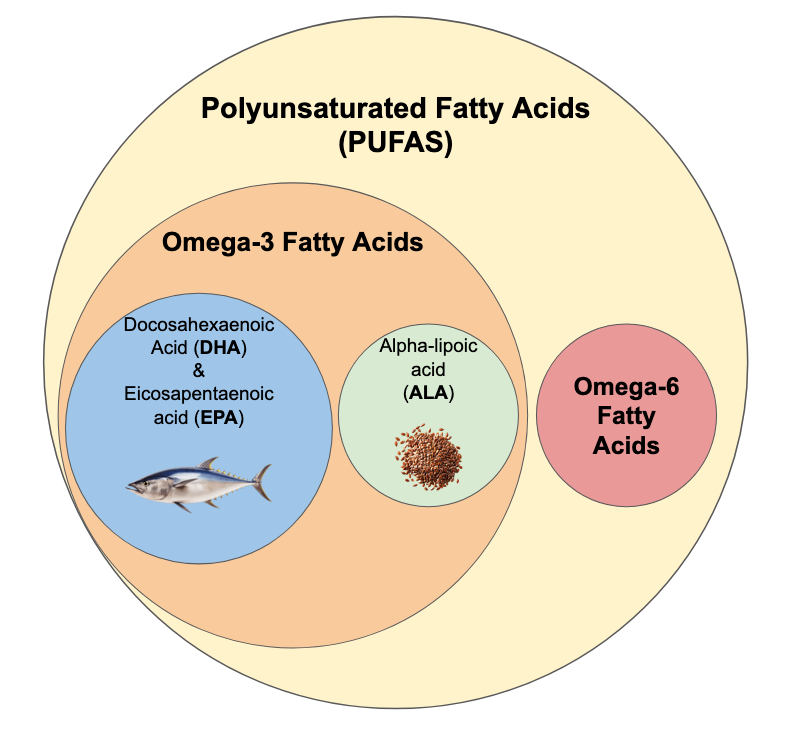
Omega-3 fatty acids are one of two major classes (along with omega-6 FAs) of polyunsaturated fatty acids (PUFAs), a type of dietary fat that are naturally found in oils in meat and produce. Our bodies are built to absorb PUFAs very efficiently, just like with any other fats that we eat.
There are many compounds that fall under the category of Omega-3 FAs. Two of the three major ones, DHA and EPA, are found in fatty marine animals (fish and seafood). The third, ALA, is a plant-based Omega-3, which is most notably found in flaxseed oil, chia seeds, and walnuts.
One thing the body does with ALA is convert it into the very useful DHA and EPA, however the efficiency of this process is not very high, which is why ALA is not recommended as a fish oil substitute.
Fish Oil’s Recommended Intake
The effects of fish oil are quite tricky to measure because of how inconsistently they are felt between different individuals. Because of this, the “adequate” intake published by the National Academy of Medicine (listed below) is less of a rigorous, scientifically determined recommendation, but instead more of an approximation, based on limited studies and observations.
| Adequate Intake | ||||
|---|---|---|---|---|
| Age | Male | Female | Pregnancy | Lactation |
| Birth to 6 months | 0.5 g | 0.5 g | ||
| 7–12 months | 0.5 g | 0.5 g | ||
| 1–3 years | 0.7 g | 0.7 g | ||
| 4–8 years | 0.9 g | 0.9 g | ||
| 9–13 years | 1.2 g | 1.0 g | ||
| 14+ years | 1.6 g | 1.1 g | 1.4 g | 1.3 g |
There are two ways of obtaining fish oil in your system: supplements, or eating seafood.
If you don’t like eating seafood, the FDA has approved fish oil supplements. These little capsules are sold over-the-counter in grocery stores, pharmacies and general stores in varying dosages, but the FDA does not recommend taking more than 2 grams a day.
However, fish oil supplements are quite dubious in effect. While it is well known that cultures and populations that eat a lot of fish receive many health benefits, clinical trials often fail to reproduce these effects when feeding patients plain fish oil in pill form. (This will be further elaborated on in the Fact or Fiction review of clinical studies!)
Therefore, if you have the palette for it, eating fish and seafood is the best option! One benefit that is linked to dietary fish consumption is improved heart health. Accordingly, the American Heart Association recommends eating fish twice a week.

Image Credit: https://pixabay.com/photos/salmon-cooked-food-fish-herbs-1238248/
Just three ounces of cooked atlantic salmon, or about half an adult serving, has 1.24 grams of DHA and 0.59 grams of EPA for a total of 1.83 grams of omega-3s! Other good sources of DHA and EPA are canned fish and oysters.
Don’t worry about not getting enough, as dangerous levels of fish oil deficiency are largely observed only in malnutriated individuals. Symptoms of low fish oil include rough, scaly skin and dermatitis. Otherwise, deficiency is determined by bloodwork.
The Pros and Cons
| Category: Low Risk, Low Reward | |
|---|---|
| Pros | Cons |
| Anti-inflammatory | Belching |
| Increased metabolism (Helps burn fat)* | Indigestion |
| Lowers cholesterol* | Acid Reflux |
| May improve eye health** | |
Summary Table of Pros and Cons of Fish Oil
Anti-Inflammation: In multiple clinical trials, fish oils contributed to pain relief in patients with rheumatoid arthritis, inflammatory bowel disease, and general joint pain.
*Increased Metabolism and Lowered Cholesterol: Both reduced triglycerides (fat) and cholesterol levels are well studied in mice models, however the effects are less well observed in humans. Read the advanced article for more information on the molecular pathways involved!
Eye Health: DHA is an important molecule used in the cells that make up your eyes! In particular, clinical trials have suggested that Age-Related Macular Degeneration may be improved with taking fish oil. This is further elaborated in the next section.
You may notice that a few of fish oil’s biggest, boldest claims are missing from this table. Where is the lowered cardiovascular disease, or the improved brain health? As it turns out, extensive clinical studies have been conducted investigating these supposed benefits. What they found is also summarized in the next section below!
Fact or Fiction? Three Myths on Omega-3 Fatty Acids (Clinical Trials)
There’s a lot of talk around the effects of omega-3 fatty acids. In this section, we’ll briefly cover the findings of major clinical trials on Omega-3s. For brevity, only the major findings are included. For more depth, please visit the extended article!
Claim 1: Omega-3 fatty acids reduce the risk of cognitive decline.
Verdict: Unproven.
Omega-3 supplementation has no impact on cognitive function, and does not slow cognitive decline in most individuals.
Trials:
| TRIAL/STUDY NAME | NUMBER OF PARTICIPANTS | COGNITIVE EFFECTS? |
| Rotterdam Study(1996) | 5395 | No effects after 6 years |
| AREDS2(2005) | 2073 | None |
| OmegaAD(2004) | 204 | None in most, slowed decline for very mild AD |
| Quinn et al.(2009) | 295 | None |
| Lee et al.(2012) | 32 | Yes; improved memory! |
Summary Table of Clinical Trials on Cognitive Impact
Claim 2: Omega-3s improve Age-Related Macular Degeneration (AMD)
Verdict: There is an effect! Omega-3s may potentially be a cheap and accessible option for treatment of AMD.
Trials:
| TRIAL/STUDY NAME | NUMBER OF PARTICIPANTS | EFFECTS? |
| AREDS2(2005) | 2132 | Lowered risk of AMD progression |
| AREDS2(2005) | 1837 | 30% reduction in disease progression |
Summary Table of Clinical Trials on Effect on Age Related Macular Degeneration
Claim 3: Omega-3s reduce risk for heart disease.
Verdict: Unproven.
However, diets high in fish are associated with lowered risk for cardiovascular diseases. Just as the American Heart Association recommends, a high fish/seafood diet will likely benefit you! Especially compared to taking fish oil supplements.
| TRIAL/STUDY NAME | NUMBER OF PARTICIPANTS | EFFECTS? |
| ASCEND(2005) | 15,480 | Same risk of vascular events |
| VITAL (2010-2015) | 26,000 | Same risk of cardiovascular disease*19% reduction in individuals with higher fish diets found |
Summary Table of Clinical Trials on Effect on Cardiovascular Health
Conclusion
Fish oil appears to be a low risk, low reward kind of supplement. While there are some benefits, they seem relatively minor and unreliable as a cure to poor health. However, similarly the “negatives” aren’t much harmful. Similar to many health practices, do what you feel good about doing. If you feel there is an improvement to your health by taking fish oil pills, don’t be discouraged by the data. Fish oil does have proven benefits, and many are still subjects of scientific research. However if you didn’t feel anything, this may be a sign to save your money instead. Regardless, eating fish and seafood remains an unchallenged method of staying healthy, so perhaps go and treat yourself to some salmon this week!