Curcumin
Section 1: Executive summary and clinical status
Curcumin is a natural compound found in turmeric that has gained attention for its possible anti-inflammatory, antioxidant, anticancer, and brain-protective effects. Much of this interest comes from curcumin’s ability to influence pathways in the body that are involved in inflammation and cell health. One of the main pathways studied is the NF-κB pathway, which helps control inflammation, immune responses, and cell survival.
Studies suggest that curcumin may help reduce inflammation by blocking NF-κB activity and lowering the production of inflammatory signals. Because long-term inflammation is linked to conditions such as type 2 diabetes, heart disease, arthritis, Alzheimer’s disease, and cancer, curcumin is often studied as a compound with potential health benefits.
However, curcumin has an important limitation: the body does not absorb it very well. When taken by mouth, curcumin does not dissolve easily in water, is broken down quickly, and is removed from the body fast. This means that even when high amounts are consumed, only a small amount may actually reach the blood and tissues.
Because of this, there is still a gap between what curcumin can do in laboratory studies and how well it works in humans. Other factors, such as its reaction to light and possible effects on iron levels, also need to be considered. Overall, curcumin is a promising compound, but more research is needed to understand how it can be used safely and effectively.
Section 2: Molecular signaling pathways
NF-κB Inhibition and Anti-Inflammatory Properties
Curcumin has been extensively studied for its anti-inflammatory properties, with much of its activity attributed to its effects on the nuclear factor kappa B (NF-κB) signaling pathway. NF-κB is a transcription factor that regulates the expression of numerous genes involved in inflammation, immune responses, cell proliferation, and survival. When activated, NF-κB promotes the production of pro-inflammatory cytokines and other mediators that contribute to chronic inflammatory states.
Research suggests that curcumin can suppress NF-κB activation, thereby reducing the expression of inflammatory signaling molecules. This mechanism has made curcumin a compound of interest for conditions characterized by persistent inflammation. Chronic inflammation is recognized as a contributing factor in the development and progression of numerous diseases, including type 2 diabetes, arthritis, cardiovascular disease, and certain cancers.
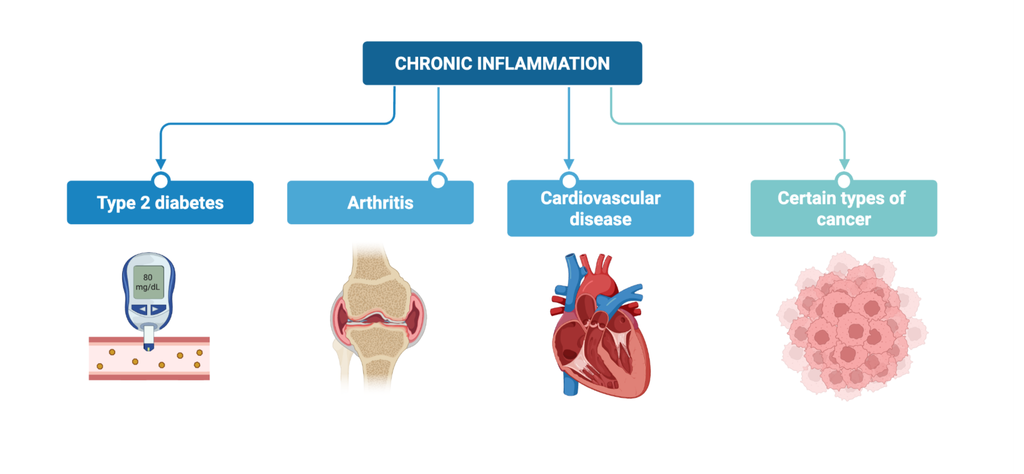
Chronic Inflammation as a Contributing Factor in Certain Diseases.
Created in https://BioRender.com
Curcumin Inhibition of NF-κB Signaling
One of the primary mechanisms underlying curcumin’s anti-inflammatory effects is its ability to inhibit the NF-κB signaling pathway. NF-κB regulates the expression of numerous genes involved in inflammation, immune responses, cell survival, and disease progression.
Curcumin interferes with an early stage of the NF-κB activation cascade by preventing the phosphorylation and subsequent degradation of IκBα, an inhibitory protein that binds NF-κB and retains it in the cytoplasm. When IκBα is preserved, NF-κB is unable to move into the nucleus and activate gene transcription. As a result, curcumin can suppress the expression of numerous pro-inflammatory and disease-associated genes. This inhibition of NF-κB signaling is considered one of the most extensively studied mechanisms through which curcumin may exert its anti-inflammatory effects.
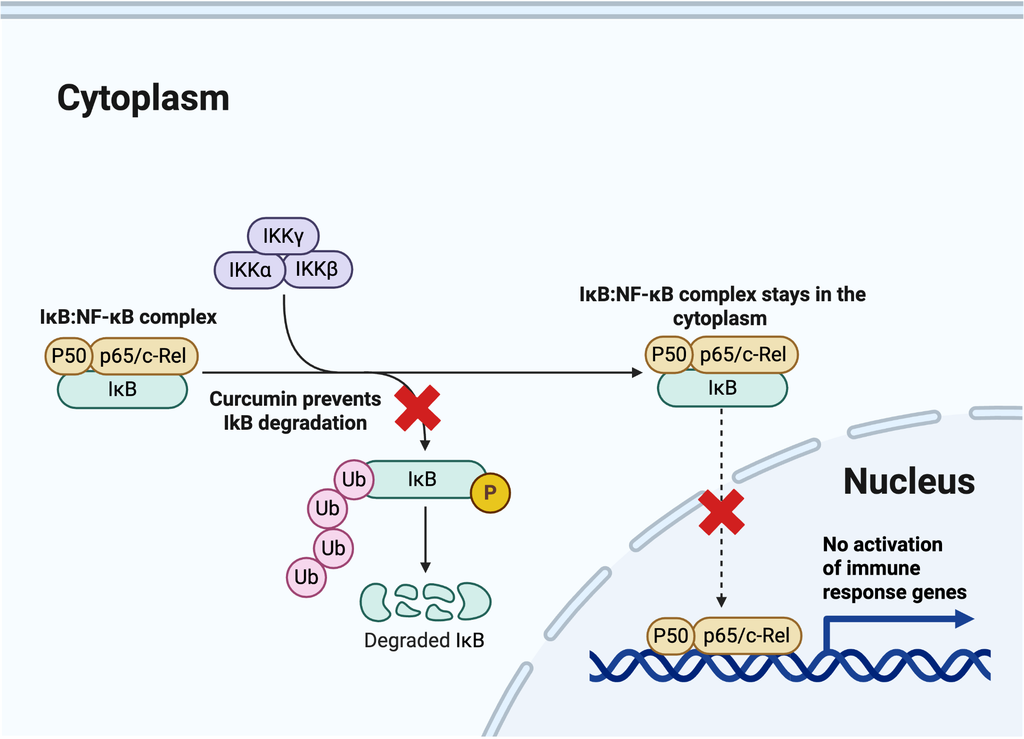
Curcumin Inhibition of NF-κB Signaling.
Created in https://BioRender.com
NF-κB Inhibition and TNF-α–Mediated Apoptosis
Although cancer is not classified as a chronic inflammatory disease, cancer is closely associated with inflammation.
NF-kB and apoptosis (programmed cell death)
In addition to its role in inflammation, NF-κB functions as an anti-apoptotic transcription factor that helps cells resist programmed cell death. One of the key signaling molecules involved in this process is tumor necrosis factor-alpha (TNF-α), a cytokine capable of triggering both pro-survival and pro-apoptotic pathways within the cell.
When TNF-α binds to its receptor, TNFR1, it can initiate apoptosis through signaling proteins such as FADD. (4) Alternatively, TNF-α signaling can activate NF-κB through intermediary proteins including RIP and TRAF2. (4) These pathways compete with one another, and the balance between them ultimately determines whether the cell survives or undergoes apoptosis.
Upon activation, NF-κB translocates to the nucleus and promotes the expression of genes that inhibit apoptosis and enhance cell survival. As a result, cells can become resistant to TNF-induced death signals. (4) Conversely, when NF-κB activation is suppressed, the apoptotic pathway predominates, increasing the likelihood of programmed cell death.
Because curcumin inhibits NF-κB signaling, it may reduce the expression of anti-apoptotic genes and increase the susceptibility of cancer cells to apoptosis. This mechanism has generated significant interest in curcumin as a potential agent for cancer prevention and treatment. (4)
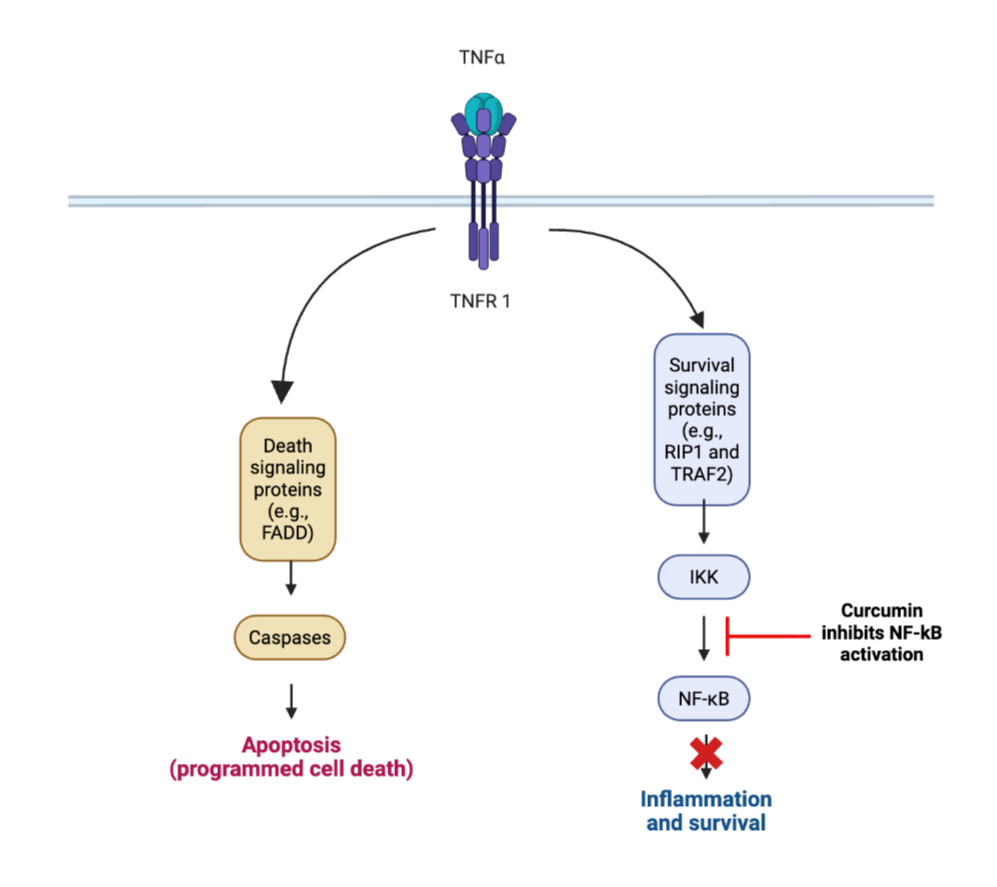
TNF-α Signaling Pathways and How Curcumin Promotes Apoptosis.
Created in https://BioRender.com
Suppression of angiogenesis—the formation of new blood vessels from existing ones:
Angiogenesis is crucial for normal physiological processes such as growth and wound healing, as it allows tissues to receive oxygen and nutrients through the formation of new blood vessels.
However, in conditions like cancer, angiogenesis enables tumor growth and spread by forming new blood vessels that supply the tumor with oxygen and nutrients. Therefore, regulating angiogenesis is an important therapeutic strategy, and compounds like curcumin have been studied for their ability to inhibit this process by targeting key signaling pathways involved in blood vessel formation.
Curcumin may suppress angiogenesis by directly affecting endothelial cells, which are the cells that form new blood vessels. Curcumin can inhibit the JNK pathway, which helps regulate endothelial cell movement during angiogenesis. (3)
Antioxidant
Oxygen is necessary for cells to make energy, but it can also form highly reactive molecules, which can harm cell membranes, DNA, and proteins. When the body has too many oxidants and not enough antioxidant defenses, oxidative stress occurs. This can damage cells and contribute to diseases such as inflammation, atherosclerosis, arthritis, cancer, Parkinson’s disease, and Alzheimer’s disease.
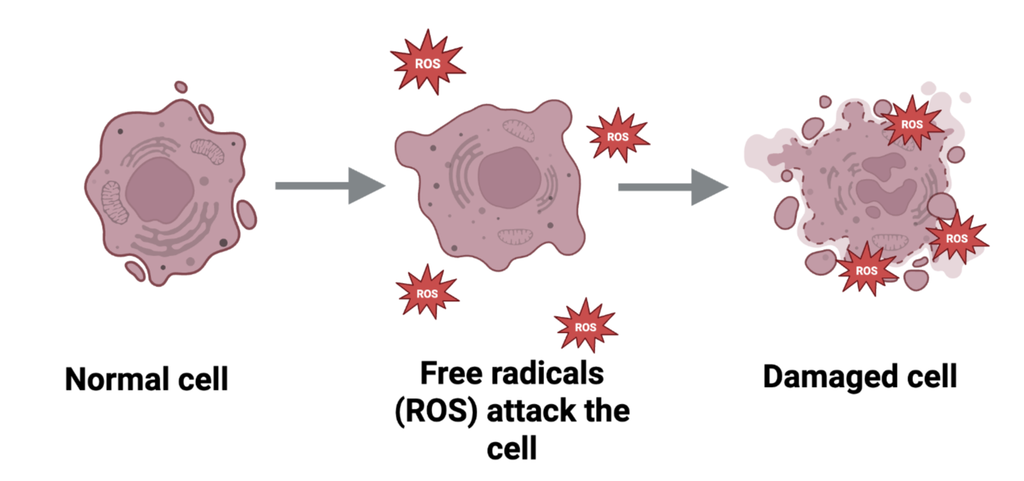
Oxidative Stress.
Created in https://BioRender.com
Curcumin acts as an antioxidant by protecting cell membranes from damage caused by free radicals. It scavenges (neutralizing) reactive oxygen species, which prevents lipid peroxidation—a chain reaction that damages cell membranes. (5) Its antioxidant ability comes from its chemical structure, especially its phenolic groups and central methylenic group, which can donate hydrogen atoms to stabilize harmful radicals.
Curcumin can neutralize free radicals through mechanisms like hydrogen atom transfer (HAT) or electron transfer (SPLET), depending on the environment. Additionally, curcumin can break down into other compounds (like ferulic acid and vanillin) that also have antioxidant properties, further enhancing its protective effects. (5)
Neuroprotective and Inhibition of protein aggregation
Neurodegeneration is commonly associated with oxidative stress, chronic inflammation, and the accumulation of toxic protein aggregates in the brain.
- Curcumin may have neuroprotective effects because
- It can help reduce β-amyloid accumulation, a hallmark of Alzheimer’s disease.
- It can bind to Aβ and prevent it from aggregating into toxic plaques.
- Curcumin may also lower BACE1 expression, which reduces the production of new Aβ, and decrease inflammatory signals like TNF-α that contribute to amyloid buildup.
- In addition, its antioxidant and anti-inflammatory properties help protect neurons from oxidative stress and inflammation caused by Aβ toxicity.
- Experimental studies show that curcumin can reduce oxidative damage, protect neurons after injury (such as stroke or trauma), and even improve markers of brain aging by decreasing lipid peroxidation and enhancing antioxidant defenses. (6)
- Several studies on transgenic mouse models* have found that curcumin in the diet that can cross the blood-brain barrier can reduce the buildup of amyloid-beta and plaque formation.
* transgenic mouse models: mice that have been genetically engineered to carry specific genes, in this case genes associated with Alzheimer’s disease.
Poor bioavailability
A major limitation of curcumin is its poor bioavailability, meaning that only a small amount is absorbed and utilized by the body. After oral consumption, curcumin is poorly soluble in water, rapidly metabolized in the liver and intestines, and quickly eliminated from the body. As a result, even high doses often lead to very low concentrations in the bloodstream and tissues, limiting its effectiveness in human clinical settings.
To address this issue, researchers have developed various strategies to improve curcumin’s bioavailability. These include combining curcumin with compounds like piperine, the main compound of black pepper, to enhance absorption. Additionally, modified forms of curcumin (analogs) are being explored to increase stability and bioactivity. (9)
Phototoxicity
Curcumin can become phototoxic when exposed to visible light in the presence of oxygen. Under these conditions, curcumin acts as a photosensitizer, absorbing light energy and transferring it to surrounding oxygen molecules to generate reactive oxygen species (ROS), including singlet oxygen and other reduced forms of molecular oxygen. These ROS are highly reactive and can damage lipids, proteins, and DNA within cells. Studies have shown that this effect occurs across multiple biological systems. For example, curcumin has been found to be phototoxic to bacteria such as Salmonella typhimurium and Escherichia coli even at very low concentrations when irradiated with visible light. Similar phototoxic effects have also been demonstrated in mammalian cells, including rat basophilic leukemia cell models, with oxygen being essential for this process. (3)
Curcumin shows promising potential as a photosensitizer in photodynamic therapy because it becomes biologically active only when exposed to light. In this study, researchers found that curcumin alone caused no toxicity to Rat Basophilic Leukemia cells in the dark, and light alone also had no toxic effect. However, when the cells were illuminated in the presence of curcumin, cell survival decreased rapidly, demonstrating that curcumin can be activated by visible light to produce cytotoxic effects.
This selective light-dependent activity makes curcumin especially interesting for photodynamic therapy. The study also showed that curcumin’s phototoxicity required oxygen, suggesting that light activation leads to the formation of reactive oxygen species or oxidative photoproducts that damage nearby cells. Because curcumin remains relatively non-toxic without light but becomes cytotoxic upon irradiation, it may offer therapeutic potential for targeted treatments such as destroying cancer cells while minimizing damage to surrounding healthy tissue. (8)
Curcumin and Iron Homeostasis
In the 2000s, the idea of curcumin being an active iron chelator, which binds iron and reduces how much iron is available, was commonly discussed. In a study conducted on mice by Jiao et. al., curcumin affects iron levels in vivo. In mice, curcumin significantly reduced key indicators of iron status, including serum iron, hemoglobin, hematocrit, and transferrin saturation. It also lowered iron stores in major organs such as the liver, spleen, and bone marrow. Importantly, these effects were most significant in mice with already low or borderline iron levels, where curcumin induced a phenotype similar to iron-deficiency anemia. The study confirmed that this effect was not due to toxicity or impaired intestinal absorption, as curcumin did not damage the gastrointestinal tract. Instead, the results suggest that curcumin directly alters iron homeostasis within the body. (10)
A study in 2021 supported the finding that curcumin does not interfere with short-term iron absorption. The results of this randomized clinical trial found that a bioavailable form of curcumin (HydroCurc™) did not impair iron absorption when taken alongside ferrous sulfate, a commonly used iron supplement. Participants who took iron showed expected increases in serum iron, transferrin saturation, and hemoglobin levels, regardless of whether curcumin was included. Importantly, curcumin did not reduce these effects at either low or high iron doses. Overall, the study demonstrates that, in the short term, formulated curcumin does not negatively affect iron uptake in healthy individuals. (11)
Separate sections
*INFLAMMATION
Inflammation is a fundamental component of the body’s immune response. It occurs when the immune system detects pathogens, harmful substances, or tissue damage and initiates a coordinated response to eliminate the threat and begin the repair process. This response involves the activation of immune cells, signaling molecules, and inflammatory pathways that help restore normal tissue function.
Inflammation can be classified as either acute or chronic. Acute inflammation is a short-term response that typically resolves once the underlying injury or infection has been addressed. In this context, inflammation is beneficial and plays an essential role in healing and recovery.
In contrast, chronic inflammation persists for months or even years, often due to ongoing immune activation or the failure of normal regulatory mechanisms. Unlike acute inflammation, chronic inflammation can cause progressive tissue damage and disrupt normal physiological function. A growing body of evidence links chronic inflammation to the development and progression of numerous diseases, including cardiovascular disease, type 2 diabetes, chronic obstructive pulmonary disease (COPD), autoimmune disorders, and certain cancers. Because chronic inflammation is implicated in so many age-related and chronic diseases, researchers have devoted significant attention to compounds that may modulate inflammatory pathways.
NF-kB signaling pathway overview
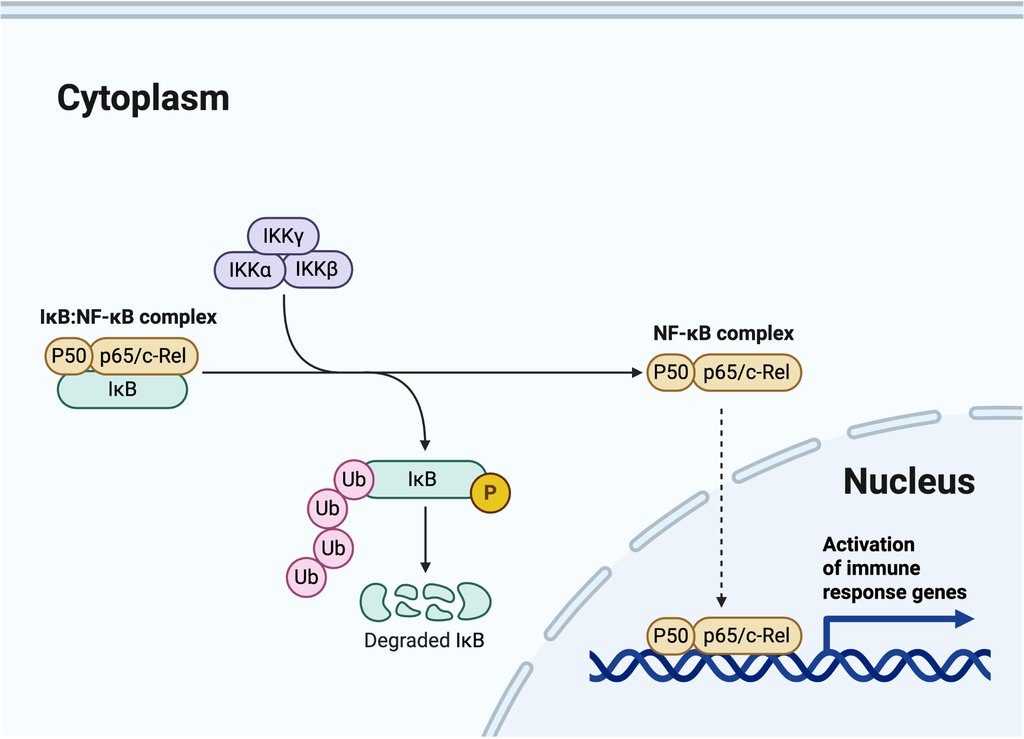
NF-κB signaling pathway activation.
Created in https://BioRender.com
The NF-κB (nuclear factor kappa B) signaling pathway is a central regulator of inflammation, immunity, cell survival, and proliferation. It consists of a family of transcription factors formed from five subunits (p50, p52, RelA/p65, RelB, and c-Rel) that combine into dimers to control gene expression. Under normal conditions, NF-κB remains inactive in the cytoplasm, bound to inhibitory proteins called IκB. (2)
When a cell encounters a stimulus such as TNF-α, the pathway is activated through the IKK (IκB kinase) complex. IKK phosphorylates IκB, marking it for ubiquitination and subsequent degradation by the proteasome. Once IκB is degraded, NF-κB is released and moves into the nucleus, where it binds to κB DNA sites and promotes the transcription of genes involved in inflammation, including cytokines, chemokines, and survival factors. (2) When NF-κB is not properly regulated, it can contribute to many diseases, including severe inflammation, immune complications, viral replication, tissue damage, atherosclerosis, and cancer. Because of its role in these conditions, NF-κB is considered an important target for developing treatments. (1)
Reference
Chronic Inflammation: https://europepmc.org/article/nbk/nbk493173?utm_medium=email&utm_source=transaction
Inflammation: Cause of all disease https://www.mdpi.com/2073-4409/13/22/1906
- Activation of Transcription Factor NF-κB Is Suppressed by Curcumin (Diferuloylmethane)
https://www.jbc.org/article/S0021-9258(18)87080-6/fulltext
(2) NF-kB in Health and Disease (book)
(3) Anticancer Potential of Curcumin: Preclinical and Clinical Studies. Link
(4) Apoptosis and nuclear factor-κb: a tale of association and dissociation https://www.sciencedirect.com/science/article/pii/S0006295200003932
(5) ANTIOXIDANT AND ANTI-INFLAMMATORY PROPERTIES OF CURCUMIN (p.123-)
(6) NEUROPROTECTIVE EFFECTS OF CURCUMIN https://link.springer.com/content/pdf/10.1007/978-0-387-46401-5.pdf#page=123 (p.213-)
(7) BENEFICIAL ROLE OF CURCUMIN IN SKIN DISEASES
https://link.springer.com/content/pdf/10.1007/978-0-387-46401-5.pdf#page=123 (p.357-)
(8) Phototoxicity of Curcumin
https://onlinelibrary.wiley.com/doi/epdf/10.1111/j.1751-1097.1994.tb05036.x
(9) Bioavailability of Curcumin: Problems and Promises
https://pubs.acs.org/doi/full/10.1021/mp700113r
(10) Curcumin, a cancer chemopreventive and chemotherapeutic agent, is a biologically active iron chelator
(11) Acute Administration of Bioavailable Curcumin Alongside Ferrous Sulphate Supplements Does Not Impair Iron Absorption in Healthy Adults in a Randomised Trial