

Metformin
Metformin (dimethylbiguanide) is the most widely prescribed oral antihyperglycemic agent globally, used as a first-line therapy for type 2 diabetes mellitus (T2D). It is derived from the plant Galega Officinalis and has evolved from being a traditional herbal remedy to a pharmacological agent with many applications. Throughout this article, we will trace metformin’s origins from clinical introduction to a possible longevity treatment. Additionally, it will address the molecular mechanisms metformin goes through such as AMP-activated protein kinase (AMPK) activation, autophagy, mTOR pathway suppression, and the modulation of the gut microbiome. Trials will also be addressed from model organisms like C. elegans, mice, Drosophila, and rats as well as human clinical trials like the UK Prospective Diabetes Study and TAME (Targeting Aging with Metformin). Finally, we will address the controversies surrounding metformin and its side-effects.
Why it’s Important:
Diabetes mellitus, specifically type 2-diabetes (T2D), is one of the most significant global health challenges affecting approximately 537 million adults, predicted to rise to 783 by 2045. Management of this chronic disorder has been transformed by the development of metformin and other diabetes therapy options.
Original Discovery:
Metformin’s use in diabetes management traces back to traditional herbal medicine in southern Europe and western Asia. A plant native to these areas: Galega Officinalis, was prepared to alleviate symptoms associated with what was likely undiagnosed diabetes. The active ingredient responsible for these benefits was identified in the early 20th century as guanidine. Guanidine and its derivatives were found to reduce blood sugar by inhibiting glucose production in the liver and increasing glucose uptake by peripheral tissues. This discovery sparked interest in biguanides like phenforin, buformin, and metformin.
Jean Sterne, a French physician and pharmacologist, was the first to report on metformin’s antihyperglycemic properties in 1957. Sterne deemed metformin as a ‘Glucophage’ (glucose eater), however metformin’s progression to a T2D therapy was impeded by the association of the biguanide class with lactic acidosis. Other biguanides named phenformin and buformin were associated with fatal lactic acidosis, causing them to be withdrawn from the market by the late 1970s. Metformin was determined to have a distinctly different structure than others in its class and notably a lower risk of lactic acidosis when used at therapeutic doses. Therefore, regulatory agencies and clinicians were extremely cautious of using metformin as a pharmaceutical. The caution was overcome by evidence demonstrating metformin’s safety profile, since metformin had less potent effects on inhibiting mitochondrial oxidative phosphorylation, decreasing risk for lactic acidosis compared to the other two biguanides. In 1995 metformin was finally approved by the FDA after many European trials confirmed that metformin was a safe diabetes treatment option. Since then metformin has become a cornerstone therapy option for T2D.
Mechanisms of Action:
One of the mechanisms behind metformin’s blood glucose lowering properties is through inhibiting hepatic gluconeogenesis and decreasing lipogenesis. Hepatic gluconeogenesis is the de novo synthesis of glucose from non-carbohydrate precursors like lactate, glycerol, and amino acids. Within hepatocytes, the body’s processing center, metformin is taken up by the organic cation transporter 1 (OCT1) encoded by the SLC22A1 gene. Metformin is accumulated in cells and the mitochondria because it is positively charged. At a molecular level, metformin inhibits mitochondrial complex 1, which is the first enzyme in the mitochondrial electron transport chain. The inhibition of MTOR1 reduces the mitochondrial membrane potential, lowering the ATP/ADP ratio and elevating AMP levels.
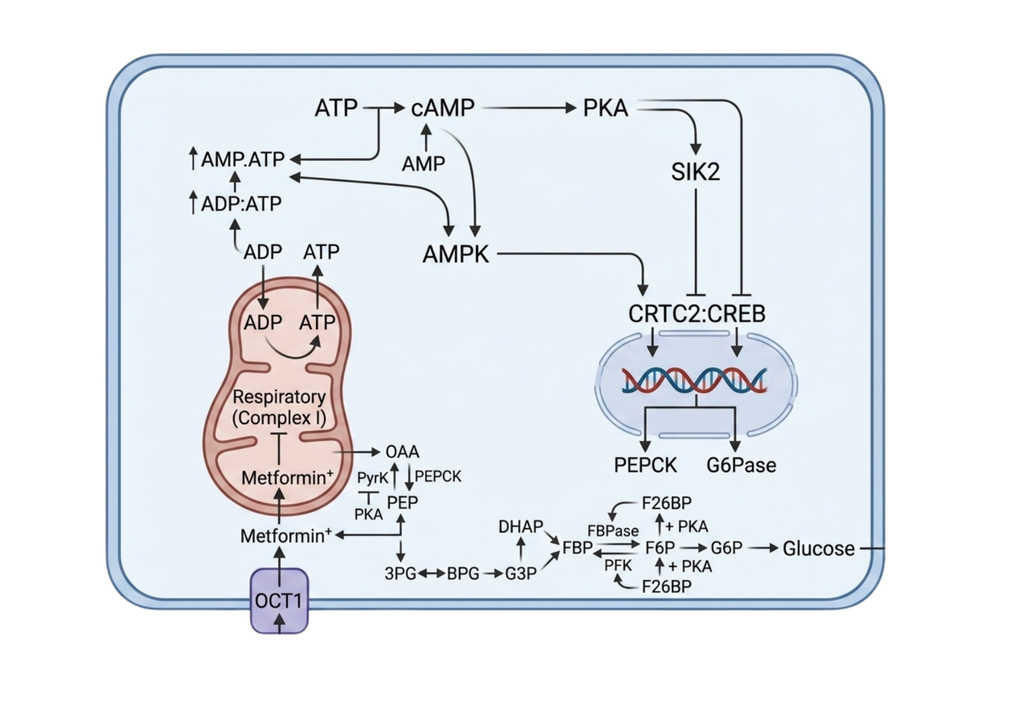
A rise in AMP and ADP levels after MTOR1 inhibition causes activation of the AMP-activated protein kinase (AMPK) which is a serine/threonine kinase that regulates cellular energy homeostasis. Specifically, AMPK phosphorylates and inhibits transcriptional coactivators of hepatic glucose production like CRTC2 (CREB-regulated transcription coactivator 2) and CBP (CREB-binding protein). These coactivators drive the expression of gluconeogenic enzymes like phosphoenolpyruvate carboxykinase (PEPCK) and glucose-6-phosphate (G6Pase). Both of these enzymes are crucial to the gluconeogenic process, so these inhibitions cause reduced transcription of gluconeogenic genes and decrease hepatic glucose output which lower fasting blood glucose levels. Additionally, there has been research to prove that AMP may have an additional AMPK-independent effect on the liver, lowering cAMP and reducing production of gluconeogenic enzymes. There are still some discrepancies on whether the AMPK or AMPK-independent pathways are the prominent causes of decreased hepatic glucose production.
Chronic low-grade inflammation is a hallmark of aging and a driver of multiple age-related diseases including T2D, cardiovascular disease, neurodegeneration, and cancer. Metformin causes anti-inflammatory effects through multiple pathways. AMPK activation suppresses the NF-kB (nuclear factor kappa-light-chain-enhancer of activated B cells) signaling pathway in the liver, which is a regulator of inflammatory gene expression.
Beyond the liver, metformin increases insulin sensitivity in peripheral tissues like skeletal muscle and adipose tissue. Skeletal tissue is the major site of postprandial glucose disposal, where metformin stimulates glucose uptake via the AMPK-mediated translocation of GLUT4 (a glucose transporter) to the plasma membrane. This process mimics insulin signaling and is very valuable in T2D where insulin resistance contributes to hyperglycemia. This mechanism utilizes indirect AMPK activators like LKB1, AMPD, and mitochondria as well as direct upregulation of AMPK. AMPK has a diverse amount of interactions within these cells including epigenetic responses causing upregulation of the transcription and translation of the GLUT4 gene and TBC1D1, Rab4, and CbI upregulation causing increased translocation of GLUT4 from transport vesicles to the cell wall. Metformin also reduces free fatty acid levels and improves lipid metabolism through the activation of AMPK. The resulting effect is promotion of fatty acid oxidation and suppression of lipogenesis which reduces ectopic lipid accumulation in the liver and skeletal muscle.

One of the most important effects of AMPK activation by metformin is the inhibition of the mechanistic target of rapamycin complex 1 (mTORC1) which is a nutrient-sensing kinase complex that coordinates cell growth, protein synthesis, and autophagy. AMPK phosphorylates tuberous sclerosis complex 2 (TSC2), which enhances its GTPase-activating activity toward the mTORC1 activator Rheb, reducing mTORC1 activity. mTORC1 inhibition induces macrophages which is a cellular self degradation process where damaged organelles, protein aggregates, and pathogens are taken in and delivered to lysosomes for degradation and recycling. Autophagy maintains organellar quality control and cellular proteostasis which decline with aging, so by promoting autophagy it may clear accumulations of dysfunctional mitochondria and misfolded proteins that contribute to age-related diseases.
Another effect of Metformin is it increases GLP-1 secretion from L-cells in the jejunum, ileum, and colon. GLP-1 (*link*) is hormone that works through the cAMP (*link*) pathway in alpha and beta cells of the pancreas. When blood glucose rises, GLP-1 stimulates insulin secretion and stimulates glucagon; when glucose falls, it backs off to prevent hypoglycemia. Metformin may also further amplify GLP-1 levels by hindering bile acid reabsorption in the ileum. Proposed mechanisms indicate that Metformin blocks FXR (Farnesoid X Receptor) activity through an AMPK-mediated process. These elevated bile acid levels indirectly stimulate GLP-1 secretion from L-cells. Additionally, Metformin inhibits DPP-4, the enzyme that normally degrades GLP-1.
Beyond just glycemic control, evidence has revealed there are a plethora of effects associated with metformin use: cardiovascular protection, anti-inflammatory action, anti-oxidant properties, anti-cancer properties, and potential modulation of the aging process. These possibilities have repositioned metformin as not only an antidiabetic drug but also a candidate for longevity.
Proposed Anti-Aging Properties
One of the first implications of metformin’s possible anti-aging properties was its cardiovascular benefits for T2D patients found by the United Kingdom Prospective Diabetes Study (UKPDS). **link to discussion of the trial** Subsequent mechanistic studies have identified multiple potential explanations for metformin’s cardioprotective effects. These include: reduction of LDL cholesterol and triglycerides via AMPK-mediated suppression of hepatic lipogenesis, anti-platelet and anti-thrombotic effects, direct cardioprotective signaling via AMPK activation in cardiomyocytes, and reduction of endothelial dysfunction.
Additionally, scientists have demonstrated that metformin provides protection from neurocognitive disorders associated with diabetes. Patients diagnosed with diabetes have increased risks of dementia and Alzheimer’s disease since the glucose transporter correlated with insulin relates to memory. A research study at the University of Washington completed a study on newly diagnosed TD2 patients to scan for the impacts of insulin resistance on the brain. The study indicated that insulin resistance does correlate to increased risk for Alzheimer’s. Although the delay of cognitive decline in T2D patients using metformin has shown to be efficient, the efficacy in the nondiabetic population is unknown. Model organism studies on mice have indicated there are potential benefits of metformin in cognitive decline, by “reducing neuroinflammation, reducing autophagy, and increasing mTOR signaling.” However, additional testing is needed to determine if these results are repeatable and reflective in humans.
Model Organism Studies
Scientists began investigating metformin’s longevity benefits by performing trials on model organisms, in particular C. elegans. Researchers have begun testing life-span extending effects of metformin on C. elegans, which is an optimal organism to test lifespan extending effects on because they have a short 2 week lifespan and an easily manipulated genome. Studies have shown that inactivation of genes involved with biguanides caused a reduction in lifespan, which indicates that metformin may have longevity effects. Additionally, metformin given at high doses extended the lifespan by 40% in C. elegans, whereas low dosages seem to have no effect. These life-enhancing effects are assumed to be a result of metformin’s alteration of microbial folate and methionine metabolism. The lifespan extension of C. elegans appeared to involve many pathways we discussed before: AMPK and microbial metabolism. In C. elegans with a loss-of-function aak-2 mutant (gene for AMPK) showed lower lifespan when treated with metformin. As well as, altering their microbiome modified the metabolism of E. coli, which is what C. elegans feed on, which generates folate cycle alterations that contributed to lifespan extension.
Rodent studies of metformin’s longevity effects have yielded complex and informative results. The National Institute on Aging’s Interventions Testing Program (ITP) tested longevity interventions on mice, including a dietary dose of 0.1% metformin. Treatment on middle-aged mice (~12 months) produced a statistically significant increase in mean lifespan of about 5-6%. A higher dose of metformin at 1% was found to be toxic in mice, which is consistent with dose-dependent adverse effects on C. elegans. Researchers also found that mice treated when they were younger produced higher increases in mean lifespan of 14%. Age dependence may reflect that metformin’s effects depend on younger organisms’ better ability to respond to metabolic reprogramming.
In contrast to the results found from mice and C. elegans, trials on Drosophila melanogaster and rats have not demonstrated lifespan extension with metformin. Through multiple trials on male and female Drosophila there was no effect on lifespan and toxicity at higher dosages. In rats similar studies have failed reporting the same toxicity at higher dosages. These results demonstrate that the longevity effects of metformin are not conserved across all species and varying metabolic physiology or gut microbiome composition can make longevity unaffected by metformin.
Human Studies for Metformin Anti-Aging Properties:
The cardiovascular benefits of metformin were initially found by the UK Prospective Diabetes Study, which determined that T2D patients receiving glucose therapy had reduced risk of microvascular complications. The study selected 4209 patients with newly diagnosed T2D to undergo either dietary restriction or glucose therapy (metformin for overweight patients, sulfonylurea or insulin). The study concluded that there was reduced risk for death and myocardial infarction. Metformin specifically was used for overweight T2D patients, the results determined that risk-reduction was sustained after the trial period. These cardiovascular effects were the first sign that metformin might have longevity benefits.
The Targeting Aging with Metformin (TAME) trial, running underneath Dr. Nir Barzilai at Albert Einstein College of Medicine, is the first clinical study specifically designed to determine whether pharmacological interventions can delay aging in humans. The trial is a randomized, double blind, placebo-controlled trial with approximately 3,000 participants between ages 65-79 without diabetes, but with at least one age-related condition (cardiovascular disease, cancer history, or cognitive impairments). One endpoint of TAME is a composite outcome counting the time to first occurrence of a new age-related disease. The trial aims to capture the concept of “multimorbidity delay” rather than a single disease prevention. Another endpoint is measuring the physical function, cognitive performance, biomarkers of aging like epigenetic clocks, and patient-reported outcomes. If successful, the TAME trial would establish a regulatory and conceptual framework for approving drugs that target aging as a disease-modifying strategy.
Side effects of Metformin:
Despite metformin’s favorable safety record, enthusiasm for metformin as a longevity intervention must be tempered by acknowledging and understanding the risks that come along with it. Along with not being FDA approved for longevity treatment, metformin has some negative side-effects including: GI effects, Vitamin B12 Deficiency, Lactic Acidosis, and uncertainty of targets.
GI Effects:
Metformin has been reported in up to 20% of T2D patients to cause gastrointestinal issues like nausea, diarrhea, indigestion, and vomiting. GI intolerance in patients being treated with metformin is not completely understood, however scientists hypothesize it could be due to an “accumulation of serotonin, histamine, bile acids,… or OCT1 gene polymorphism.” (source) In this systematic review, they determined that the dosage size and use of metformin over other T2D treatments did not cause a statistical increase in GI side-effects. Although GI issues may seem rather minimal, the accumulation of GI effects along with side effects of T2D or other health issues is compounding.
Vitamin B12 Deficiency:
Long-term metformin use has been associated with causing a Vitamin B12 deficiency in Type 2 Diabetic patients, due to it decreasing the absorption of B12 in the small intestine. The mechanism involving the interference of calcium-dependent ileal absorption of the vitamin B12-intrinsic factor complex is impaired by metformin. It has been found that Metformin causes a Vitamin B12 deficiency in ~30% of patients and a deficiency in Vitamin B12 can lead to lethargy, weakness, and vision problems.
Lactic Acidosis:
A rarer side-effect of Metformin is the drug’s association with an increased risk of Lactic Acidosis in patients with abnormal kidney function. Lactic Acidosis is a metabolic condition where lactic acid builds up in the bloodstream faster than the body can filter it out through their kidneys and liver. Metformin causes an increase of lactate production and can lower lactate clearance rates, so with abnormal kidney function lactate can build-up. Lactic acid build-up in the blood stream causes negative side effects like fatigue, nausea, and more severely: heart failure and neurological changes. This side-effect is not common, however a drug similar to Metformin, Phenformin, was removed from the market due to its significant increase in risk for Lactic Acidosis.
Uncertainty of Targets:
Metformin is known to be a very promiscuous drug that has upwards of 745 identified proteins that it alters. Its broad molecular footprint is filled with interactions that are poorly understood, meaning that some could be beneficial while others detrimental. Understanding which of these many targets are important and cause impacts on a healthy body is important data to understand long-term benefits and consequences of Metformin.
Species Differences and Translational Challenges:
The inconsistent findings across model organisms bring to light the inherent challenges of translating animal data to human longevity. The genetic and environmental heterogeneity of human populations vastly exceeds inbred laboratory strains and understanding individual variation of metformin responses (OCT1 polymorphisms, gut microbiome composition, and metabolic health) is likely to produce a wide variability in outcomes.
Overall Conclusions of Evidence for Longevity:
The field of metformin research is entering an exciting phase shaped by several converging developments. The results of the TAME trial will provide the first and most definitive human evidence regarding metformin’s capacity to delay anti-aging related diseases in non-diabetic older adults. These results will either validate previous conclusions or cause a calibration of expectations and research directions. Additionally, medical advancements will allow scientists to determine which subpopulations are most likely to benefit from metformin’s effects. Analyses of OCT1 and OCT2 variants, gut microbiome profiling, and epigenetic biomarkers will enable personalized prescriptions that maximize benefits and minimize adverse effects. Finally, as the mechanisms behind metformin continue to be researched, new pathways and known pathways will hopefully be solidified to determine with certainty where and what metformin acts upon.
| Category | Rating of Evidence | Explanation |
| Human Evidence | Weak | Although there are promising trials being completed, there have been no results released (currently) that prove metformin has longevity effects on healthy humans. |
| Model Organism Trials | Moderate | There are promising longevity results from model organism trials on C. elegans and mice, however the lack of evidence from Drosophila and rats limits the credibility of the other trials. |
| Mechanistic Plausability | High | The mechanisms that metformin interacts with, especially mTOR1 and AMPK pathways, are known to interact with aging in cells. Therefore, there is promise that metformin’s interaction with these pathways could lead to anti-aging properties. |
| Evidence for Longevity Claims | Preliminary | Although no formal conclusions have been drawn for metformin’s ability to produce anti-aging properties, there are ongoing trials to produce more evidence. |
| Evidence Consistency | Mixed | The results in model organism trials vary and different researchers report varying findings. |
| Safety Confidence | Medium | Metformin has some rare severe side effects but the common side effects are minimal. With proper testing on humans and model organisms scientists will be able to determine if metformin is fit for the general public. |