

Metformin and Longevity
What is Metformin?
Metformin traces its roots to Galega Officinalis, a French Lilac flower, which was used in the medieval times as medicine. Researchers discovered its blood sugar lowering properties in the early 1900s and by the mid-1900s it became a cornerstone treatment for Type 2 Diabetes. Metformin’s reputation for reducing blood sugar has held constant for many decades and it is an effective and relatively inexpensive diabetes drug. However, over the past two decades a quieter hypothesis has gained traction: that metformin may be able to slow the underlying biology of aging. Preliminary trials have found that metformin may delay aging markers in model organisms, and the hope is that these benefits are translated into humans. The field of longevity (*link*) has become increasingly popular in recent years, so it is important to understand the benefits, risks, mechanisms of metformin, and that the pharmaceutical is unapproved for longevity purposes by the FDA. Individuals should not take Metformin for longevity purposes until concrete evidence is released that it has positive impacts on aging. As well as, weighing whether the individual’s benefits outweigh the risks if approved.
According to the Hallmarks of Aging, there are 12 different categories that determine someone’s biological age. Metformin has promising effects on some of these 12 categories including: regulating macrophagy, improving neurocognition, cardiovascular outcomes, and anti-inflammatory effects.
How does Metformin Work?
Metformin is taken orally either as a short-release or long-release pill which is then absorbed in the small intestine. Metformin disrupts glucose absorption into the blood stream from the small intestine, which is why the drug is beneficial for Type-2 Diabetic patients. Metformin also encourages the release of glucose into the small intestine, ridding the body of extra glucose. Metformin is also correlated with increased insulin secretion which causes the pancreas to release glucose when levels are too high. All of these factors cause decreased blood glucose levels and are effective to reduce glucose retention.
What are Some Proposed Anti-Aging Properties of Metformin?
Cardiovascular Evidence:
Some of the earliest clues for the Metformin’s anti–aging hypothesis came from cardiovascular research. Researchers completed a study, the UK Prospective Diabetes Study (UKPDS), on Type 2 Diabetic patients and found that metformin might reduce the atherosclerotic burden. There have been clinical studies completed that observed variable positive outcomes, and general cardiovascular protective functions like reducing oxidative stress and inflammation responses.
Neurocognitive Evidence:
Research has also shown that metformin may be correlated with reduced rates of cognitive decline in diabetic populations. It’s known that Type 2 Diabetes has negative effects on brain structure, associated with thinning the brain’s outer layer. This increases the T2D population’s risk for neurological disorders, one of the most common being Alzheimer’s disease. It has been shown that metformin treatments on T2D patients have reduced the risk of dementia and were correlated with improvements of cognitive impairments. However, more targeted research is necessary to confirm whether these conclusions expand beyond just the T2D population.
Microbiome Evidence:
Additionally, recent research has been found that Metformin impacts the gut microbiome of patients, causing an increase in bacteria that produce short-chain fatty acids. Short chain fatty acids are correlated with reducing systemic inflammation and improving metabolic regulation. This research is preliminary, so scientists are still attempting to uncover the precise mechanisms behind this benefit.
Model Organism Evidence:
Scientists have been testing Metformin on model organisms like C. elegans, mice, rats, and Drosophila. It has been found that Metformin extended the lifespan of C. elegans and mice. These discoveries led scientists to focus research on Metformin’s effects on aging processes. It is important to note that scientists also found that lifespan was not increased for rats and Drosophila. The biology of how Metformin reacts with model organisms and human bodies appears to be more context-dependent than initially thought. However, these findings are important as they sharpened scientific interest on Metformin’s possible anti-aging properties.
Current Human Trials:
Trials of Metformin’s benefits and side-effects on patients are coming up for healthy individuals and some have already begun for pre-diabetic individuals. An upcoming trial on healthy individuals is the TAME trial (Targeting Aging with Metformin). The TAME trial is planned to test 3,000 patients between the ages of 65 to 79 to determine if the pharmaceutical delays the “development or progression of age-related chronic diseases – such as heart disease, cancer, and dementia” (SOURCE). Additionally, trials on pre-diabetic patients have begun their pilot phases, most prominently the MILES trial (Metformin in Longevity Study). This trial aims to see if Metformin can alter gene expression related to aging, however a much wider spread trial is necessary to confirm any results.
Being Wary of the “Hype” Around Metformin:
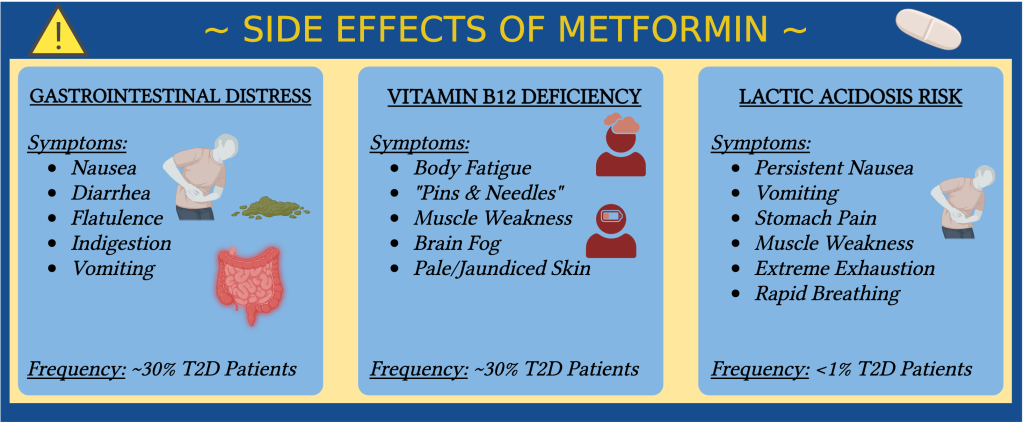
Although there are some promising findings for metformin promoting anti-aging, there have been no proven results in humans. Additionally, as do many other drugs, there are some negative side effects from taking metformin. Metformin has caused gastrointestinal issues, Vitamin B12 deficiencies, and Lactic Acidosis.
GI Effects:
The most common side-effect of taking Metformin is gastrointestinal issues (GI) such as diarrhea, nausea, flatulence, indigestion, and vomiting. GI effects are seen in about 30% of diabetic patients, however less than 5% of those affected have to stop taking Metformin due to GI issues. It is important to note that these side-effects, although seemingly manageable, can have major adverse effects on patients suffering from a serious disease.
Vitamin B12 Deficiency:
Metformin has also been associated with causing a Vitamin B12 deficiency in Type 2 Diabetic patients, due to it decreasing the absorption of B12 in the small intestine. Vitamin B12 is a fortified vitamin your body needs to obtain from food to form healthy red blood cells and keep proper nerve function. It has been found that Metformin causes a Vitamin B12 deficiency in ~30% of patients. A deficiency in Vitamin B12 can lead to lethargy, weakness, and vision problems.
Lactic Acidosis:
A rarer side-effect of Metformin is the drug’s association with an increased risk of Lactic Acidosis in patients with abnormal kidney function. Lactic Acidosis is a metabolic condition where lactic acid builds up in the bloodstream faster than the body can filter it out through their kidneys and liver. Metformin causes an increase of lactate production and can lower lactate clearance rates, so with abnormal kidney function lactate can build-up. Lactic acid build-up in the blood stream causes negative side effects like fatigue, nausea, and more severely: heart failure and neurological changes. This side-effect is not common, however a drug similar to metformin: phenformin, was removed from the market due to its significant increase in risk for Lactic Acidosis.
Bottom line:
Although there are some promising results for Metformin’s effect on aging, there have been no significant human trials published that demonstrate concrete evidence. The use of Metformin for off-label treatment such as longevity or to decrease cardiovascular risk, is not FDA approved. The fundamental challenge with Metformin is that it affects every individual differently, and the mechanisms behind these interactions are poorly understood. Aging itself is different for every individual and follows different biological trajectories. Therefore, a drug calibrated to a population’s “average aging” may not be suitable for some and counterproductive for others. This is why many researchers argue that before Metformin can be responsibly used as an aging intervention on a large-scale, the field needs better tools. These tools should aim to understand the specific biomarkers of individuals that can identify who will benefit from Metformin and detect harm early-on before irreparable damage is done.